Kamis, 30 Desember 2010

ASAM BASA

Water

We typically talk about acid-base reactions in aqueous-phase environments -- that is, in the presence of water. The most fundamental acid-base reaction is the dissociation of water:

H2O H+ + OH-

In this reaction, water breaks apart to form a hydrogen ion (H+) and a hydroxide ion (OH-). In pure water, we can define a special equilibrium constant (Kw) as follows:

KW = [H+][OH-] = 1.00x10⁻¹⁴

Where Kw is the equilibrium constant for water at 25° C (unitless)
[H+] is the molar concentration of hydrogen
[OH-] is the molar concentration of hydroxide

An equilibrium constant less than one (1) suggests that the reaction prefers to stay on the side of the reactants -- in this case, water likes to stay as water. Because water hardly ionizes, it is a very poor conductor of electricity.

pH

What is of interest in this reading, however, is the acid-base nature of a substance like water. Water actually behaves both like an acid and a base. The acidity or basicity of a substance is defined most typically by the pH value, defined as below:

pH = -log[H+]

At equilibrium, the concentration of H+ is 1.00 × 10⁻⁷, so we can calculate the pH of water at equilibrium as:

pH = -log[H+]= -log[1.00 × 10⁻⁷] = 7.00

Solutions with a pH of seven (7) are said to be neutral, while those with pH values below seven (7) are defined as acidic and those above pH of seven (7) as being basic.

pOH gives us another way to measure the acidity of a solution. It is just the opposite of pH. A high pOH means the solution is acidic while a low pOH means the solution is basic.

pOH = -log[OH-]

pH + pOH = 14.00 at 25°C

Definitions of acids and bases

  • Arrhenius
    acid: generates [H+] in solution
    base: generates [OH-] in solution
    normal Arrhenius equation: acid + base salt + water
    example: HCl(aq) + NaOH(aq) NaCl(aq) + H2O(l)

  • Brønsted-Lowery:
    acid: anything that donates a [H+] (proton donor)
    base: anything that accepts a [H+] (proton acceptor)
    normal Brønsted-Lowery equation: acid + base acid + base
    example: HNO2(aq) + H2O(aq) NO2-(aq)+ H3O+(aq)
    Each acid has a conjugate base and each base has a conjugate acid. These conjugate pairs only differ by a proton. In this example: NO2- is the conjugate base of the acid HNO2 and H3O+ is the conjugate acid of the base H2O.

  • Lewis:
    acid: accepts an electron pair
    base: donates an electron pair
    The advantage of this theory is that many more reactions can be considered acid-base reactions because they do not have to occur in solution.

Salts

A salt is formed when an acid and a base are mixed and the acid releases H+ ions while the base releases OH- ions. This process is called hydrolysis. The pH of the salt depends on the strengths of the original acids and bases:

AcidBaseSalt pH
strongstrongpH = 7
weakstrong pH > 7
strongweak pH <>
weakweak depends on which is stronger

These salts are acidic or basic due to their acidic or basic ions. When weak acids or weak bases react with water, they make strong conjugate bases or conjugate acids, respectively, which determines the pH of the salt.

Acid-Base Character

For a molecule with a H-X bond to be an acid, the hydrogen must have a positive oxidation number so it can ionize to form a positive +1 ion. For instance, in sodium hydride (NaH) the hydrogen has a -1 charge so it is not an acid but it is actually a base. Molecules like CH4 with nonpolar bonds also cannot be acids because the H does not ionize. Molecules with strong bonds (large electronegativity differences), are less likely to be strong acids because they do not ionize very well. For a molecule with an X-O-H bond (also called an oxoacid) to be an acid, the hydrogen must again ionize to form H+. To be a base, the O-H must break off to form the hydroxide ion (OH-). Both of these happen when dealing with oxoacids.

Strong Acids: These acids completely ionize in solution so they are always represented in chemical equations in their ionized form. There are only seven (7) strong acids:

HCl, HBr, HI, H2SO4, HNO3, HClO3, HClO4

To calculate a pH value, it is easiest to follow the standard "Start, Change, Equilibrium" process.

Example Problem: Determine the pH of a 0.25 M solution of HBr.

Answer:

HBr (aq) → H+(aq) + Br-(aq)
  Start: .25 M
0 M
0 M
  Change: -.25
+.25
+.25
  Equilibrium: 0
.25
.25

pH = -log[H+] = -log(.25) = 0.60

Weak Acids: These are the most common type of acids. They follow the equation:

HA(aq) H+(aq) + A-(aq)

The equilibrium constant for the dissociation of an acid is known as Ka. The larger the value of Ka, the stronger the acid.

Ka =
[H+][A-]

[HA]

Example Problem: Determine the pH of 0.30 M acetic acid (HC2H3O2) with the Ka of 1.8x10⁻⁵.

Answer:
  Write an equilibrium equation for the acid:
    HC2H3O2 H+ + C2H3O2-
  Write the equilibrium expression and the Ka value:
    Ka =
[H+][C2H3O2-]

[HC2H3O2]
= 1.8x10⁻⁵
  "Start, Change, Equilibrium":

HC2H3O2 H+ + C2H3O2-
    Start: 0.30 M
0 M
0 M
    Change: -x
+x
+x
    Equilibrium: 0.30 - x
x
x
  Substitute the variables (disregard the "-x" because it is so small compared to the 0.30)
  and solve for [H+]:
    Ka = 1.8x10-5 =
(x)(x)

(.30 - x)
=
x2

.30
    x = [H+] = 2.3x10⁻³
    pH = -log[H+] = 2.64

Strong Bases: Like strong acids, these bases completely ionize in solution and are always represented in their ionized form in chemical equations. There are only eight (8) strong bases:

LiOH, NaOH, KOH, RbOH, CsOH, Ca(OH)2, Sr(OH)2, Ba(OH)2

Example Problem: Determine the pH of a 0.010 M solution of Ba(OH)2.

Answer:

Ba(OH)2(aq) → Ba2+(aq) + 2OH-(aq)
  Start: .010 M
0 M
0 M
  Change: -.010
+.010
+.010
  Equilibrium: 0
.010
.010
  pOH = -log[OH-] = -log(.010) = 1.70
  pH = 14.00 - 1.70 = 12.30

Weak Bases: These follow the equation:

Weak Base + H2O conjugate acid + OH-

example: NH3 + H2O NH4+ + OH-

Kb is the base-dissociation constant:

Kb =
[conjugate acid][OH-]

[weak base][H2O]
example: Kb =
[NH4+][OH-]

[NH3[H2O]

Ka x Kb = Kw = 1.00x10⁻¹⁴

To calculate the pH of a weak base, we must follow a very similar "Start, Change, Equilibrium" process as we did with the weak acid, however we must add a few steps.

Example Problem: Determine the pH of 0.15 M ammonia (NH3) with a Kb=1.8x10⁻⁵.

Answer:
  Write the equilibrium equation for the base:
    NH3 + H2O NH4+ + OH-
  Write the equilibrium expression and the Kb value:
    Kb =
[NH4+][OH2-]

[NH3][H2O]
= 1.8x10⁻⁵
  "Start, Change, Equilibrium":

NH3 + H2O NH4+ + OH-
    Start: 0.15 M
--
0 M
0 M
    Change: -x
--
+x
+x
    Equilibrium: 0.15 - x
--
x
x
  Substitute the variables (disregard the "-x" because it is so small compared to the 0.15)
  and solve for [OH-]:
    Kb = 1.8x10-5 =
(x)(x)

(.15 - x)
=
x2

.15
    x = [OH-] = 1.6x10⁻³ M
    pOH = -log[OH-] = 2.80
    pH = 14.00 - 2.80 - 11.20

When dealing with weak acids and weak bases, you also might have to deal with the "common ion effect". This is when you add a salt to a weak acid or base that contains one of the ions present in the acid or base. To be able to use the same process to solve for pH when this occurs, all you need to change are your "start" numbers. Add the molarity of the ion, which comes from the salt, and then solve the Ka or Kb equation as you did earlier.

Example Problem: Find the pH of a solution formed by dissolving 0.100 mol of HC2H3O2 with a Ka of 1.8x10⁻⁸ and 0.200 mol of NaC2H3O2 in a total volume of 1.00 L.

Answer:

HC2H3O2(aq) → H+(aq) + C2H3O2-(aq)
  Start: .10 M
0 M
.20 M
  Change: -x
+x
+x
  Equilibrium: .10 - x
x
.20 + x
  Ka = 1.8x10-8 =
(x)(.20 + x)

(.10 - x)
=
(x)(.20)

(.10)
  x = [H+] = -9.0x10⁻⁹
  pH = -log(9.0x10⁻⁹) = 8.05

Acid-Base Titrations

An acid-base titration is when you add a base to an acid until the equivalence point is reached which is where the number of moles of acid equals the number of moles of base. For the titration of a strong base and a strong acid, this equivalence point is reached when the pH of the solution is seven (7) as seen on the following titration curve:
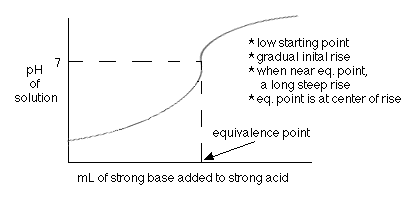
For the titration of a strong base with a weak acid, the equivalence point is reached when the pH is greater than seven (7). The half equivalence point is when half of the total amount of base needed to neutralize the acid has been added. It is at this point where the pH = pKa of the weak acid.
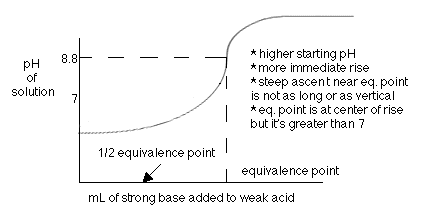
In an acid-base titration, the base will react with the weak acid and form a solution that contains the weak acid and its conjugate base until the acid is completely gone. To solve these types of problems, we will use the Ka value of the weak acid and the molarities in a similar way as we have before. Before demonstrating this way, let us first examine a short cut, called the Henderson-Hasselbalch Equation. This can only be used when you have some acid and some conjugate base in your solution. If you only have acid, then you must do a pure Ka problem and if you only have base (like when the titration is complete) then you must do a Kb problem.

pH = pKa + log
[base]

[acid]

Where:
pH is the log of the molar concentration of the hydrogen
pKa is the equilibrium dissociation constant for an acid
[base] is the molar concentration of a basic solution
[acid] is the molar concentration of an acidic solution

Example Problem: 25.0 mL of 0.400 M KOH is added to 100. mL of 0.150 M benzoic acid, HC7H5O2 (Ka=6.3x10⁻⁵). Determine the pH of the solution.

Answer:
  Determine where in the titration we are:
    0.400 M x 0.025 L = 0.0100 mol KOH added
    0.150 M x 0.100 L = 0.0150 mol HC7H5O2 originally
    because only 0.100 mol of base has been added, that means the thitration is not
    complete; this means there are two ways to solve this problem: the normal way
    and the way using the Henderson-Hasselbalch Equation.
  Normal way:

HC7H5O2 + OH-
  
C7H5O2- + H2O
    before reaction: 0.015 mol
0.0100 mol
0 mol
--
    change: -0.0100
-0.0100
+0.0100
--
    after reaction: 0.0050
0
0.0100
--
    Ka =
[H+][C7H5O2-]

[HC7H5O2]
= 6.3x10-5 =
(x)(0.0100)

0.0050
    x = [H+] = 3.2x10⁻⁵ M
    pH = -log(3.2x10⁻⁵) = 4.49
  Henderson-Hasselbalch Way:
    [HC7H5O2] =
0.0050 mol

0.125 L
= 0.040 M
    [C7H5O2-] =
0.0100 mol

0.125 L
= 0.0800 M
    pH = pKa + log
[base]

[acid]
    pH = -log(6.3x10⁻⁵) + log
0.0800

0.0400
= 4.20 + 0.30 = 4.50
This equation is used frequently when trying to find the pH of buffer solutions. A buffer solution is one that resists changes in pH upon the addition of small amounts of an acid or a base. They are made up of a conjugate acid-base pair such as HC2H3O2/C2H3O2- or NH4+/NH3. They work because the acidic species neutralize the OH- ions while the basic species neutralize the H+ ions. The buffer capacity is the amount of acid or base the buffer can neutralize before the pH begins to change to a significant degree. This depends on the amount of acid or base in the buffer. High buffering capacities come from solutions with high concentrations of the acid and the base and where these concentrations are similar in value.

CHEMICAL NOMENCLATURE

When forming compounds, it is important to know something about the way atoms will react with each other. One of the most important manners in which atoms and/or molecules react with each other is the oxidation/reduction reaction. Oxidation/Reduction reactions are the processes of losing and gaining electrons respectively. Just remember, "LEO the lion says GER:" Lose Electrons Oxidation, Gain Electrons Reduction. Oxidation numbers are assigned to atoms and compounds as a way to tell scientists where the electrons are in a reaction. It is often referred to as the "charge" on the atom or compound. The oxidation number is assigned according to a standard set of rules. They are as follows:
  1. An atom of a pure element has an oxidation number of zero.
  2. For single atoms in an ion, their oxidation number is equal to their charge.
  3. Fluorine is always -1 in compounds.
  4. Cl, Br, and I are always -1 in compounds except when they are combined with O or F.
  5. H is normally +1 and O is normally -2.
  6. The oxidation number of a compound is equal to the sum of the oxidation numbers for each atom in the compound.

Forming Ionic Compounds

Knowing the oxidation number of a compound is very important when discussing ionic compounds. Ionic compounds are combinations of positive and negative ions. They are generally formed when nonmetals and metals bond. To determine which substance is formed, we must use the charges of the ions involved. To make a neutral molecule, the positive charge of the cation (positively-charged ion) must equal the negative charge of the anion (negatively-charged ion). In order to create a neutral charged molecule, you must combine the atoms in certain proportions. Scientists use subscripts to identify how many of each atom makes up the molecule. For example, when combining magnesium and nitrogen we know that the magnesium ion has a "+2" charge and the nitrogen ion has a "-3" charge. To cancel these charges, we must have three magnesium atoms for every two nitrogen atoms:

3Mg2+ + 2N3- --> Mg3N2

Knowledge of the charges of ions is crucial to knowing the formulas of the compounds formed.

  • alkalis (1st column elements) form "+1" ions such as Na+ and Li+
  • alkaline earth metals (2nd column elements) form "2+" ions such as Mg2+ and Ba2+
  • halogens (7th column elements) form "-1" ions such as Cl- and I-

Other common ions are listed in the table below:

Positive ions (cations)Negative ions (anions)
1+1-
ammonium (NH4+)acetate (C2H3O2-)
copper(I) (Cu+)azide (N3-)
hydrogen (H+)chlorate (ClO3-)
silver (Ag+)cyanide (CN-)

dihydrogen phosphate (H2PO4-)
2+hydride (H-)
cadmium (Cd2+)bicarbonate (HCO3-)
cobalt(II) (Co2+)hydroxide (OH-)
copper(II) (Cu2+)nitrate (NO3-)
iron (Fe2+)nitrite (NO2-)
lead (Pb2+)perchlorate (ClO4-)
manganese(II) (Mn2+)permanganate (MnO4-)
mercury(I) (Hg22+)thiocyanate(SCN-)
mercury(II) (Hg2+)
nickel (Ni2+)2-
tin (Sn2+)carbonate (CO32-)
zinc (Zn2+)chromate (CrO42-)

dichromate (Cr2O72-)
3+hydrogen phosphate (HPO42-)
aluminum (Al3+)oxide (O2-)
chromium(III) (Cr3+)peroxide (O22-)
iron(III) (Fe3+)sulfate (SO42-)

sulfide (S2-)

sulfite (SO32-)

3-

nitride (N3-)

phosphate (PO43-)

phosphide (P3-)

Naming Ionic Compounds

The outline below provides the rules for naming ionic compounds:

Positive Ions

  1. Monatomic cations (a single atom with a positive charge) take the name of the element plus the word "ion"

    Examples:
    • Na+ = sodium ion
    • Zn+2 = zinc ion

  2. If an element can form more than one (1) positive ion, the charge is indicated by the Roman numeral in parentheses followed by the word "ion"

    Examples:
    • Fe2+ = iron(II) ion
    • Fe3+ = iron (III) ion
Negative Ions
  1. Monatomic anions (a single atom with a negative charge) change their ending to "-ide"

    Examples:
    • O2- = oxide ion
    • Cl- = chloride ion

  2. Oxoanions (negatively charged polyatomic ions which contain O) end in "-ate". However, if there is more than one oxyanion for a specific element then the endings are:

    Two less oxygen than the most common starts with "hypo-" and ends with "-ite" One less oxygen than the most common ends with "-ite"

    THE MOST COMMON OXOANION ENDS WITH "-ATE"


    One more oxygen than the most common starts with "per-" and ends with "-ate"
    ClO- = hypochlorite
    • ClO2- = chlorite
    • NO2- = nitrite
    • SO32- = sulfite
    Most common oxyanions with four oxygens
    • SO42- = sulfate
    • PO43- = phosphate
    • CrO42- = chromate
    Most common oxyanions with three oxygens
    • NO3- = nitrate
    • ClO3- = chlorate
    • CO32- = carbonate
    ClO4- = perchlorate

  3. Polyatomic anions (a negatively charged ion containing more than one type of element) often add a hydrogen atom; in this case, the anion's name either adds "hydrogen-" or "bi-" to the beginning

    Example:
    CO32- becomes HCO3-
    "Carbonate" becomes either "Hydrogen Carbonate" or "Bicarbonate"

  4. When combining cations and anions into an ionic compound, you always put the cation name first and then the anion name (the molecular formulas are also written in this order as well.)

    Examples:
    • Na+ + Cl- --> NaCl
      sodium + chloride --> sodium chloride
    • Cu2+ + SO42- -->CuSO4
      copper(II) + sulfate --> copper(II) sulfate
    • Al3+ + 3NO3- --> Al(NO3)3
      aluminum + nitrate --> aluminum nitrate

Arrangement of Atoms

In naming ions, it is important to consider "isomers." Isomers are compounds with the same molecular formula, but different arrangements of atoms. Thus, it is important to include some signal within the name of the ion that identifies which arrangement you are talking about. There are three main types of classification, geometric, optical and structural isomers.

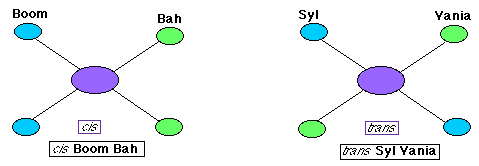
  1. Geometric isomers refers to which side of the ion atoms lie. The prefixes used to distinguish geometric isomers are cis meaning substituents lie on the same side of the ion and trans meaning they lie on opposite sides. Below is a diagram to help you remember.
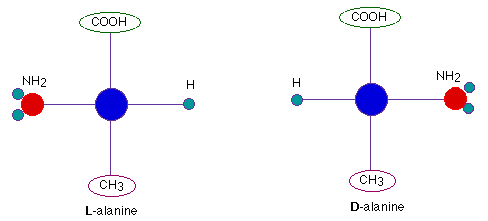
  2. Optical isomers differ in the arrangement of four groups around a chiral carbon. These two isomers are differentiated as L and D.
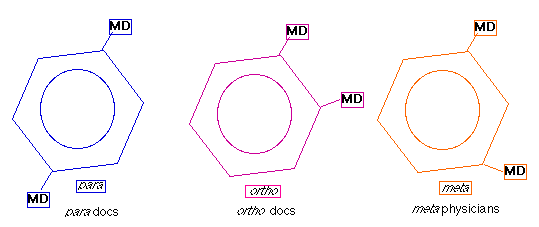
  3. Structural isomers differentiate between the placement of two chlorine atoms around a hexagonal carbon ring. These three isomers are identified as o, m, and p. Once again we have given you a few clues to help your memory.

A pop-up nomenclature calculator is available for help when naming compounds and for practice problems.

Naming Binary Molecular Compounds

Molecular compounds are formed from the covalent bonding between non-metallic elements. The nomenclature for these compounds is described in the following set of rules.

  1. The more positive atom is written first (the atom which is the furthest to the left and to the bottom of the periodic table)
  2. The more negative second atom has an "-ide" ending.
  3. Each prefix indicates the number of each atom present in the compound.
    Number of AtomsPrefixNumber of AtomsPrefix
    1 mono 6 hexa
    2 di 7 hepta
    3 tri 8 octa
    4 tetra 9 nona
    5 penta 10 deca

    Examples:
    CO2 = carbon dioxide
    P4S10 = tetraphosphorus decasulfide

Naming Inorganic Acids

  1. Binary acids (H plus a nonmetal element) are acids that dissociate into hydrogen atoms and anions in water. Acids that only release one hydrogen atom are known as monoprotic. Those acids that release more than one hydrogen atom are called polyproticacids. When naming these binary acids, you merely add "hydro-" (denoting the presence of a hydrogen atom) to the beginning and "-ic acid" to the end of the anion name.

    Examples:
    HCl = hydrochloric acid
    HBr = hydrobromic acid
  2. Ternary acids (also called oxoacids, are formed by hydrogen plus another element plus oxygen) are based on the name of the anion. In this case, the -ate, and -ite suffixes for the anion are replaced with -ic and -ous respectively. The new anion name is then followed by the word "acid." The chart below depicts the changes in nomenclature.

    Anion nameAcid name
    hypo___itehypo___ous acid
    ___ite___ous acid
    ___ate___ic acid
    per___ateper___ic acid

    Example:
    ClO4- to HClO4 => perchlorate to perchloric acid
    ClO- to HClO => hypochlorite to hypochlorous acid

Naming Compounds

A detailed treatise on naming organic compounds is beyond the scope of these materials, but some basics are presented. The wise chemistry student should consider memorizing the prefixes of the first ten organic compounds:

Number of Carbons Prefix
1 meth-
2 eth-
3 prop-
4 but-
5 pent-
6 hex-
7 hept-
8 oct-
9 non-
10 dec-
There are four basic types of organic hydrocarbons, those chemicals with only carbon and hydrogen:

  1. Single bonds (alkane): suffix is "ane", formula CnH2n+2
  2. Double bonds (alkene): suffix is "ene", formula CnH2n
  3. Triple bonds (alkyne): suffix is "yne", formula CnH2n-2
  4. Cyclic compounds: use prefix "cyclo"

    So, for example, an organic compound with the formula "C6H14" would be recognized as an alkane with six carbons, so its name is "hexane".


    Examples:
    N2O4 = dinitrogen tetraoxide
    S2F10 = disulfur decafluoride

Rabu, 06 Oktober 2010

Sistem Periodik Unsur

MACAM-MACAM SISTEM PERIODIK

1. TRIADE DOBEREINER DAN HUKUM OKTAF NEWLANDS

TRIADE DOBEREINER
Dobereiner menemukan adanya beberapa kelompok tiga unsur yang memiliki kemiripan sifat, yang ada hubungannya dengan massa atom.
Contoh kelompok-kelompok triade:
- Cl, Br dan I
- Ca, Sr dan Ba
- S, Se dan Te

HUKUM OKTAF NEWLANDS
Apabila unsur disusun berdasarkan kenaikan massa atom, maka unsur kesembilan mempunyai sifat-sifat yang mirip dengan unsur pertama, unsur kesepuluh mirip dengan unsur kedua dan seterusnya. Karena setelah unsur kedelapan sifat-sifatnya selalu terulang, maka dinamakan hukum Oktaf.(+8)
Contoh: Li (nomor atom 3) akan mirip sifatnya dengan Na (nomor atom 11) 3 ® 11

2. SISTEM PERIODIK MENDELEYEV
- Disusun berdasarkan massa atomnya dengan tidak mengabaikan sifat-sifat unsurnya.
- Lahirlah hukum periodik unsur yang menyatakan bahwa apabila unsur disusun menurut massa atomnya, maka unsur itu akan menunjukkan sifat-sifat yang berulang secara periodik.
- Beberapa keunggulan sistem periodik Mendeleyev, antara lain:
- Ada tempat bagi unsur transisi.
- Terdapat tempat-tempat kosong yang diramalkan akan diisi dengan unsur yang belum ditemukan pada waktu itu.
- Kekurangan sistem periodik ini:
Adanya empat pasal anomali, yaitu penyimpangan terhadap hukum perioditas yang disusun berdasarkan kenaikan massa atomnya. Keempat anomali itu adalah: Ar dengan K, Te dengan I, Co dengan Ni dan Th dengan Pa.

3. SISTEM PERIODIK BENTUK PANJANG
Sistem ini merupakan penyempurnaan dari gagasan Mendeleyev, disusun berdasarkan nomor atomnya.
Sistem ini terdiri dari dua deret, deret horisontal disebut periodik dan deret vertikal disebut golongan.

4. SISTEM PERIODIK DAN HUBUNGANNYA DENGAN KONFIGURASI ELEKTRON

A. HUBUNGAN ANTARA PERIODA DENGAN KONFIGURASI ELEKTRON

Dalam sistem periodik, perioda menunjukkan banyaknya kulit yang telah terisi elektron di dalam suatu atom.Sehingga sesuai dengan banyaknya kulit yaitu K, L, M, N, O, P, Q maka sistem periodik mempunyai 7 perioda.

B. HUBUNGAN ANTARA GOLONGAN DENGAN KONFIGURASI ELEKTRON

Unsur yang terletak pada satu golongan mempunyai sifat-sifat kimia yang mirip (hampir sama).

Unsur-unsur golongan A disebut golongan utama, sedangkan unsur-unsur golongan B disebut unsur transisi (peralihan), semua unsur transisi diberi simbol B kecuali untuk triade besi, paladium dan platina disebut "golongan VIII''.

- LAMBANG UNSUR-UNSUR GOLONGAN A

Lambang Golongan Nama Golongan Konfigurasi Elektron Orbital Terluar
I - A Alkali ns1
II - A Alkali tanah ns2
III - A Boron ns2 - np1
IV - A Karbon - Silikon ns2 - np2
V - A Nitogen - Posphor ns2 - np3
VI - A Oksigen ns2 - np4
VII - A Halogen ns2 - np5
VIII - A Gas mulia ns2 - np6

- LAMBANG UNSUR-UNSUR GOLONGAN B

Konfigurasi Elektron Lambang Golongan
(n - 1) d1 ns2 III - B
(n - 1) d2 ns2 IV - B
(n - 1) d3 ns2 V - B
(n - 1) d4 ns2 VI - B
(n - 1) d5 ns2 VII - B
(n - 1) d6-8 ns2 VIII
(n - 1) d9 ns2 I - B
(n - 1) d10 ns2 II - B

- GOLONGAN LANTANIDA DAN AKTINIDA, DIBERI LAMBANG

nS2 (n-2)f1-14

Jika :

n = 6 adalah lantanida
n = 7 adalah aktinida


C. CARA PENENTUAN PERIODA DAN GOLONGAN SUATU UNSUR

1. Unsur dengan nomor atom 11, konfigurasinya : 1s2 2s2 2p6 3s1

- n = 3, berarti periode 3 (kulit M).
- elektron valensi (terluar) 3s sebanyak 1 elektron, berarti termasuk golongan IA.

2. Unsur Ga dengan nomor atom 31, konfigurasinya : 1s2 2s2 2p6 3s2 3p6 4s2 3d10 4p1

- n = 4, berarti perioda 4 (kulit N).
- elektronvalensi 4s2 4p1, berarti golongan IIIA.

3. Unsur Sc dengan nomor atom 21, konfigurasinya : 1s2 2s2 2p6 3s2 3p6 4s2 3d1

- n = 4, berarti perioda 4 (kulit N).
- 3d1 4s2 berarti golongan IIIB.

4. Unsur Fe dengan nomor atom 26, konfigurasinya : 1s2 2s2 2p6 3s2 3p6 4s2 3d10

- n = 4, berarti perioda 4 (kulit N).
- 3d6 4s2 , berarti golongan VIII.


D. BEBERAPA SIFAT PERIODIK UNSUR-UNSUR

1. Jari jari atom adalah jarak dari inti atom ke lintasan elektron terluar.


- Dalam satu perioda, dari kiri ke kanan jari jari atom berkurang.

- Dalam satu golongan, dari atas ke bawah jari-jari atom bertambah.

- Jari-jari atom netral lebih besar daripada jari-jari ion positifnya tetapi lebih kecil dari jari-jari ion negatifnya.

Contoh:
jari-jari atom Cl <>-
jari-jari atom Ba > jari-jari ion Ba2+

2. Potensial ionisasi adalah energi yang diperlukan untuk melepaskan elektron yang paling lemah/luar dari atom suatu unsur atau ion dalam keadaan gas.


- Dalam satu perioda, dari kiri ke kanan potensial ionisasi bertambah.

- Dalam satu golongan, dari atas ke bawah potensial ionisasi berkurang.

3. Affinitas elektron adalah besarnya energi yang dibebaskan pada saat atom suatu unsur dalam keadaan gas menerima elektron.


- Dalam satu perioda, dari kiri ke kanan affinitas elektron bertambah.

- Dalam satu golongan, dari atas ke bawah affinitas elektron berkurang.

4. Keelektronegatifan adalah kemampuan atom suatu unsur untuk menarik elektron ke arah intinya dan digunakan bersama.

Unsur-Unsur Gas Mulia

Terdiri Atas : Helium : He
Neon : Ne
Argon : Ar
Kripton : Kr
Xenon : Xe
Radon : Rn

Sifat-Sifat Umum :
1. Tidak Berwarna, tidak berbau, tidak berasa, sedikit larut dalam air.
2. Mempunyai elektron valensi 8, dan khusus untuk Helium elektron valensinya 2, maka gas mulia bersifat kekal dan diberi valensi nol.
3. Molekul-molekulnya terdiri atas satu atom (monoatom).


Unsur Nomor Atom Konfigurasi Elektron
He 2 1s2
Ne 10 [He] 2s2 2p6
Ar 18 [Ne] 3s2 3p6
Kr 36 [Ar] 4s2 3d10 4p6
Xe 54 [Kr] 5s2 4d10 5p6
Rn 86 [Xe] 6s2 5d10 6p6

Dua elektron dari He membuat subkulit s menjadi penuh dan unsur-unsur gas mulia yang lain pada kulit terluarnya terdapat 8 elektron. karena kulit terluarnya telah penuh maka gas mulia bersifat stabil dan tidak reaktif. Jadi afinitas elektronnya mendekati nol.

Selasa, 05 Oktober 2010

Energi-Energi dan Ikatan Kimia

Reaksi kimia merupakan proses pemutusan dan pembentukan ikatan. Proses ini selalu disertai perubahan energi. Energi yang dibutuhkan untuk memutuskan ikatan kimia, sehingga membentuk radikal-radikal bebas disebut energi ikatan. Untuk molekul kompleks, energi yang dibutuhkan untuk memecah molekul itu sehingga membentuk atom-atom bebas disebut energi atomisasi.

Harga energi atomisasi ini merupakan jumlah energi ikatan atom-atom dalam molekul tersebut. Untuk molekul kovalen yang terdiri dari dua atom seperti H2, 02, N2 atau HI yang mempunyai satu ikatan maka energi atomisasi sama dengan energi ikatan Energi atomisasi suatu senyawa dapat ditentukan dengan cara pertolongan entalpi pembentukan senyawa tersebut. Secara matematis hal tersebut dapat dijabarkan dengan persamaan :
DH reaksi = S energi pemutusan ikatan - S energi pembentukan ikatan
= S energi ikatan di kiri - S energi ikatan di kanan

Contoh:

Diketahui :

energi ikatan

C - H = 414,5 kJ/Mol
C = C = 612,4 kJ/mol
C - C = 346,9 kJ/mol
H - H = 436,8 kJ/mol

Ditanya:

DH reaksi = C2H4(g) + H2(g) ® C2H6(g)


DH reaksi = Jumlah energi pemutusan ikatan - Jumlah energi pembentukan ikatan
= (4(C-H) + (C=C) + (H-H)) - (6(C-H) + (C-C))
= ((C=C) + (H-H)) - (2(C-H) + (C-C))
= (612.4 + 436.8) - (2 x 414.5 + 346.9)
= - 126,7 kJ

Penentua Perubahan Entalpi dan Hukum Hess

PENENTUAN PERUBAHAN ENTALPI

Untuk menentukan perubahan entalpi pada suatu reaksi kimia biasanya digunakan alat seperti kalorimeter, termometer dan sebagainya yang mungkin lebih sensitif.

Perhitungan : DH reaksi = S DHfo produk - S DHfo reaktan


HUKUM HESS

"Jumlah panas yang dibutuhkan atau dilepaskan pada suatu reaksi kimia tidak tergantung pada jalannya reaksi tetapi ditentukan oleh keadaan awal dan akhir."

Contoh:
C(s) + O2(g) ® CO2(g) ; DH = x kJ ® 1 tahap
C(s) + 1/2 02(g) ® CO(g) ; DH = y kJ ® 2 tahap
CO(g) + 1/2 O2(g) ® CO2(g) ; DH = z kJ
------------------------------------------------------------ +
C(s) + O2(g) ® CO2(g) ; DH = y + z kJ

Menurut Hukum Hess : x = y + z

Perubahan Entalpi

Entalpi = H = Kalor reaksi pada tekanan tetap = Qp
Perubahan entalpi adalah perubahan energi yang menyertai peristiwa perubahan kimia pada tekanan tetap.
a. Pemutusan ikatan membutuhkan energi (= endoterm)
Contoh: H2 ® 2H - a kJ ; DH= +akJ
b. Pembentukan ikatan memberikan energi (= eksoterm)
Contoh: 2H ® H2 + a kJ ; DH = -a kJ

Istilah yang digunakan pada perubahan entalpi :


1. Entalpi Pembentakan Standar ( DHf ):
DH untak membentuk 1 mol persenyawaan langsung dari unsur-unsurnya yang diukur pada 298 K dan tekanan 1 atm.

Contoh: H2(g) + 1/2 O2(g) ® H20 (l) ; DHf = -285.85 kJ


2. Entalpi Penguraian:
DH dari penguraian 1 mol persenyawaan langsung menjadi unsur-unsurnya (= Kebalikan dari DH pembentukan).

Contoh: H2O (l) ® H2(g) + 1/2 O2(g) ; DH = +285.85 kJ


3. Entalpi Pembakaran Standar ( DHc ):
DH untuk membakar 1 mol persenyawaan dengan O2 dari udara yang diukur pada 298 K dan tekanan 1 atm.

Contoh: CH4(g) + 2O2(g) ® CO2(g) + 2H2O(l) ; DHc = -802 kJ


4. Entalpi Reaksi:
DH dari suatu persamaan reaksi di mana zat-zat yang terdapat dalam persamaan reaksi dinyatakan dalam satuan mol dan koefisien-koefisien persamaan reaksi bulat sederhana.

Contoh: 2Al + 3H2SO4 ® Al2(SO4)3 + 3H2 ; DH = -1468 kJ


5. Entalpi Netralisasi:
DH yang dihasilkan (selalu eksoterm) pada reaksi penetralan asam atau basa.

Contoh: NaOH(aq) + HCl(aq) ® NaCl(aq) + H2O(l) ; DH = -890.4 kJ/mol


6. Hukum Lavoisier-Laplace
"Jumlah kalor yang dilepaskan pada pembentukan 1 mol zat dari unsur-unsurya = jumlah kalor yang diperlukan untuk menguraikan zat tersebut menjadi unsur-unsur pembentuknya."
Artinya : Apabila reaksi dibalik maka tanda kalor yang terbentuk juga dibalik dari positif menjadi negatif atau sebaliknya

Contoh:
N2(g) + 3H2(g) ® 2NH3(g) ; DH = - 112 kJ
2NH3(g) ® N2(g) + 3H2(g) ; DH = + 112 kJ

Reaksi Eksoterm dan Endoterm

Reaksi Eksoterm

Pada reaksi eksoterm terjadi perpindahan kalor dari sistem ke lingkungan atau pada reaksi tersebut dikeluarkan panas.
Pada reaksi eksoterm harga DH = ( - )

Contoh : C(s) + O2(g) ® CO2(g) + 393.5 kJ ; DH = -393.5 kJ


b.

Reaksi Endoterm

Pada reaksi endoterm terjadi perpindahan kalor dari lingkungan ke sistem atau pada reaksi tersebut dibutuhkan panas.
Pada reaksi endoterm harga DH = ( + )

Contoh : CaCO3(s) ® CaO(s) + CO2(g) - 178.5 kJ ; DH = +178.5 kJ

Tahap Menuju Kecepatan Reaksi


Dalam suatu reaksi kimia berlangsungnya suatu reaksi dari keadaan semula (awal) sampai keadaan akhir diperkirakan melalui beberapa tahap reaksi.

Contoh: 4 HBr(g) + O2(g) ® 2 H2O(g) + 2 Br2(g)

Dari persamaan reaksi di atas terlihat bahwa tiap 1 molekul O2 bereaksi dengan 4 molekul HBr. Suatu reaksi baru dapat berlangsung apabila ada tumbukan yang berhasil antara molekul-molekul yang bereaksi. Tumbukan sekaligus antara 4 molekul HBr dengan 1 molekul O2 kecil sekali kemungkinannya untuk berhasil. Tumbukan yang mungkin berhasil adalah tumbukan antara 2 molekul yaitu 1 molekul HBr dengan 1 molekul O2. Hal ini berarti reaksi di atas harus berlangsung dalam beberapa tahap dan diperkirakan tahap-tahapnya adalah :
Tahap 1: HBr + O2 ® HOOBr (lambat)
Tahap 2: HBr + HOOBr ® 2HOBr (cepat)
Tahap 3: (HBr + HOBr ® H2O + Br2) x 2 (cepat)
------------------------------------------------------ +
4 HBr + O2 --> 2H2O + 2 Br2

Dari contoh di atas ternyata secara eksperimen kecepatan berlangsungnya reaksi tersebut ditentukan oleh kecepatan reaksi pembentukan HOOBr yaitu reaksi yang berlangsungnya paling lambat.

Rangkaian tahap-tahap reaksi dalam suatu reaksi disebut "mekanisme reaksi" dan kecepatan berlangsungnya reaksi keselurahan ditentukan oleh reaksi yang paling lambat dalam mekanisme reaksi. Oleh karena itu, tahap ini disebut tahap penentu kecepatan reaksi.

Teori Tumbukan dan Teori Keadaan Transisi

Teori tumbukan didasarkan atas teori kinetik gas yang mengamati tentang bagaimana suatu reaksi kimia dapat terjadi. Menurut teori tersebut kecepatan reaksi antara dua jenis molekul A dan B sama dengan jumiah tumbukan yang terjadi per satuan waktu antara kedua jenis molekul tersebut. Jumlah tumbukan yang terjadi persatuan waktu sebanding dengan konsentrasi A dan konsentrasi B. Jadi makin besar konsentrasi A dan konsentrasi B akan semakin besar pula jumlah tumbukan yang terjadi.

TEORI TUMBUKAN INI TERNYATA MEMILIKI BEBERAPA KELEMAHAN, ANTARA LAIN :
-

tidak semua tumbukan menghasilkan reaksi sebab ada energi tertentu yang harus dilewati (disebut energi aktivasi = energi pengaktifan) untak dapat menghasilkan reaksi. Reaksi hanya akan terjadi bila energi tumbukannya lebih besar atau sama dengan energi pengaktifan (Ea).


- molekul yang lebih rumit struktur ruangnya menghasilkan tumbukan yang tidak sama jumlahnya dibandingkan dengan molekul yang sederhana struktur ruangnya.

Teori tumbukan di atas diperbaiki oleh tcori keadaan transisi atau teori laju reaksi absolut. Dalam teori ini diandaikan bahwa ada suatu keadaan yang harus dilewati oleh molekul-molekul yang bereaksi dalam tujuannya menuju ke keadaan akhir (produk). Keadaan tersebut dinamakan keadaan transisi. Mekanisme reaksi keadaan transisi dapat ditulis sebagai berikut:

A + B ® T* --> C + D

dimana:

- A dan B adalah molekul-molekul pereaksi
- T* adalah molekul dalam keadaan transisi
- C dan D adalah molekul-molekul hasil reaksi

SECARA DIAGRAM KEADAAN TRANSISI INI DAPAT DINYATAKAN SESUAI KURVA BERIKUT


Dari diagram terlibat bahwa energi pengaktifan (Ea) merupakan energi keadaan awal sampai dengan energi keadaan transisi. Hal tersebut berarti bahwa molekul-molekul pereaksi harus memiliki energi paling sedikit sebesar energi pengaktifan (Ea) agar dapat mencapai keadaan transisi (T*) dan kemudian menjadi hasil reaksi (C + D).

Catatan :
energi pengaktifan (= energi aktivasi) adalah jumlah energi minimum yang dibutuhkan oleh molekul-molekul pereaksi agar dapat melangsungkan reaksi.

Orde Reaksi

Orde reaksi adalah banyaknya faktor konsentrasi zat reaktan yang mempengaruhi kecepatan reaksi.
Penentuan orde reaksi tidak dapat diturunkan dari persamaan reaksi tetapi hanya dapat ditentukan berdasarkan percobaan.

Suatu reaksi yang diturunkan secara eksperimen dinyatakan dengan rumus kecepatan reaksi :

v = k (A) (B) 2

persamaan tersebut mengandung pengertian reaksi orde 1 terhadap zat A dan merupakan reaksi orde 2 terhadap zat B. Secara keselurahan reaksi tersebut adalah reaksi orde 3.

Contoh soal:

Dari reaksi 2NO(g) + Br2(g) ® 2NOBr(g)

dibuat percobaan dan diperoleh data sebagai berikut:
No. (NO) mol/l (Br2) mol/l Kecepatan Reaksi
mol / 1 / detik
1. 0.1 0.1 12
2. 0.1 0.2 24
3. 0.1 0.3 36
4. 0.2 0.1 48
5. 0.3 0.1 108

Pertanyaan:

a. Tentukan orde reaksinya !
b. Tentukan harga k (tetapan laju reaksi) !

Jawab:
a.

Pertama-tama kita misalkan rumus kecepatan reaksinya adalah V = k(NO)x(Br2)y : jadi kita harus mencari nilai x den y.
Untuk menentukan nilai x maka kita ambil data dimana konsentrasi terhadap Br2 tidak berubah, yaitu data (1) dan (4).
Dari data ini terlihat konsentrasi NO naik 2 kali sedangkan kecepatan reaksinya naik 4 kali maka :

2x = 4 ® x = 2 (reaksi orde 2 terhadap NO)

Untuk menentukan nilai y maka kita ambil data dimana konsentrasi terhadap NO tidak berubah yaitu data (1) dan (2). Dari data ini terlihat konsentrasi Br2 naik 2 kali, sedangkan kecepatan reaksinya naik 2 kali, maka :

2y = 2 ® y = 1 (reaksi orde 1 terhadap Br2)

Jadi rumus kecepatan reaksinya : V = k(NO)2(Br2) (reaksi orde 3)

b.

Untuk menentukan nilai k cukup kita ambil salah satu data percobaan saja misalnya data (1), maka:

V = k(NO)2(Br2)
12 = k(0.1)2(0.1)

k = 12 x 103 mol-212det-1

Konsentrasi dan Kecepatan Reaksi

Kecepatan reaksi adalah banyaknya mol/liter suatu zat yang dapat berubah menjadi zat lain dalam setiap satuan waktu.

Untuk reaksi: aA + bB ® mM + nN
maka kecepatan reaksinya adalah:
1 (dA) 1 d(B) 1 d(M) 1 d(N)
V = - ------- = - ------- = + -------- = + ----------
a dt b dt m dt n dt

dimana:
- 1/a . d(A) /dt = rA = kecepatan reaksi zat A = pengurangan konsentrasi zat A per satuan wakru.
- 1/b . d(B) /dt = rB = kecepatan reaksi zat B = pengurangan konsentrasi zat B per satuan waktu.
- 1/m . d(M) /dt = rM = kecepatan reaksi zat M = penambahan konsentrasi zat M per satuan waktu.
- 1/n . d(N) /dt = rN = kecepatan reaksi zat N = penambahan konsentrasi zat N per satuan waktu.

Pada umumnya kecepatan reaksi akan besar bila konsentrasi pereaksi cukup besar. Dengan berkurangnya konsentrasi pereaksi sebagai akibat reaksi, maka akan berkurang pula kecepatannya.

Secara umum kecepatan reaksi dapat dirumuskan sebagai berikut:

V = k(A) x (B) y

dimana:

V = kecepatan reaksi
k = tetapan laju reaksi
x = orde reaksi terhadap zat A
y = orde reaksi terhadap zat B
(x + y) adalah orde reaksi keseluruhan
(A) dan (B) adalah konsentrasi zat pereaksi.

Kesetimbangan Disosiasi

Disosiasi adalah penguraian suatu zat menjadi beberapa zat lain yang lebih sederhana.

Derajat disosiasi adalah perbandingan antara jumlah mol yang terurai dengan jumlah mol mula-mula.

Contoh:

2NH3(g) « N2(g) + 3H2(g)

besarnya nilai derajat disosiasi (a):

a = mol NH3 yang terurai / mol NH3 mula-mula


Harga derajat disosiasi terletak antara 0 dan 1, jika:

a = 0 berarti tidak terjadi penguraian
a = 1 berarti terjadi penguraian sempurna
0 <
a <>

Contoh:

Dalam reaksi disosiasi N2O4 berdasarkan persamaan

N2O4(g) « 2NO2(g)

banyaknya mol N2O4 dan NO2 pada keadaan setimbang adalah sama.

Pada keadaan ini berapakah harga derajat disosiasinya ?

Jawab:

Misalkan mol N2O4 mula-mula = a mol
mol N2O4 yang terurai = a
a mol ® mol N2O4 sisa = a (1 - a) mol
mol NO2 yang terbentuk = 2 x mol N2O4 yang terurai = 2 a
a mol

Pada keadaan setimbang:

mol N2O4 sisa = mol NO2 yang terbentuk

a(1 - a) = 2a a ® 1 - a = 2 a ® a = 1/3

Pengaruh Katalisator Terhadap Kesetimbangan dan Hubungan Antara Kc dan Kp

PENGARUH KATALISATOR TERHADAP KESETIMBANGAN

Fungsi katalisator dalam reaksi kesetimbangan adalah mempercepat tercapainya kesetimbangan dan tidak merubah letak kesetimbangan (harga tetapan kesetimbangan Kc tetap), hal ini disebabkan katalisator mempercepat reaksi ke kanan dan ke kiri sama besar.


HUBUNGAN ANTARA HARGA Kc DENGAN Kp

Untuk reaksi umum:

a A(g) + b B(g) « c C(g) + d D(g)


Harga tetapan kesetimbangan:

Kc = [(C)c . (D)d] / [(A)a . (B)b]

Kp = (PCc x PDd) / (PAa x PBb)

dimana: PA, PB, PC dan PD merupakan tekanan parsial masing-masing gas A, B. C dan D.


Secara matematis, hubungan antara Kc dan Kp dapat diturunkan sebagai:

Kp = Kc (RT) Dn

dimana Dn adalah selisih (jumlah koefisien gas kanan) dan (jumlah koefisien gas kiri).

Contoh:

Jika diketahui reaksi kesetimbangan:

CO2(g) + C(s) « 2CO(g)

Pada suhu 300o C, harga Kp= 16. Hitunglah tekanan parsial CO2, jika tekanan total dalaun ruang 5 atm!

Jawab:

Misalkan tekanan parsial gas CO = x atm, maka tekanan parsial gas CO2 = (5 - x) atm.

Kp = (PCO)2 / PCO2 = x2 / (5 - x) = 16 ® x = 4

Jadi tekanan parsial gas CO2 = (5 - 4) = 1 atm

Pergeseran Kesetimbangan

Azas Le Chatelier menyatakan: Bila pada sistem kesetimbangan diadakan aksi, maka sistem akan mengadakan reaksi sedemikian rupa sehingga pengaruh aksi itu menjadi sekecil-kecilnya.

Perubahan dari keadaan kesetimbangan semula ke keadaan kesetimbangan yang baru akibat adanya aksi atau pengaruh dari luar itu dikenal dengan pergeseran kesetimbangan.

Bagi reaksi:

A + B « C + D

KEMUNGKINAN TERJADINYA PERGESERAN

1. Dari kiri ke kanan, berarti A bereaksi dengan B memhentuk C dan D, sehingga jumlah mol A dan Bherkurang, sedangkan C dan D bertambah.

2. Dari kanan ke kiri, berarti C dan D bereaksi membentuk A dan B. sehingga jumlah mol C dan Dherkurang, sedangkan A dan B bertambah.

FAKTOR-FAKTOR YANG DAPAT MENGGESER LETAK KESETIMBANGAN ADALAH :

a. Perubahan konsentrasi salah satu zat
b. Perubahan volume atau tekanan
c. Perubahan suhu

A. PERUBAHAN KONSENTRASI SALAH SATU ZAT

Apabila dalam sistem kesetimbangan homogen, konsentrasi salah satu zat diperbesar, maka kesetimbangan akan bergeser ke arah yang berlawanan dari zat tersebut. Sebaliknya, jika konsentrasi salah satu zat diperkecil, maka kesetimbangan akan bergeser ke pihak zat tersebut.

Contoh: 2SO2(g) + O2(g) « 2SO3(g)

- Bila pada sistem kesetimbangan ini ditambahkan gas SO2, maka kesetimbangan akan bergeser ke kanan.
- Bila pada sistem kesetimbangan ini dikurangi gas O2, maka kesetimbangan akan bergeser ke kiri.

B. PERUBAHAN VOLUME ATAU TEKANAN

Jika dalam suatu sistem kesetimbangan dilakukan aksi yang menyebabkan perubahan volume (bersamaan dengan perubahan tekanan), maka dalam sistem akan mengadakan berupa pergeseran kesetimbangan.

Jika tekanan diperbesar = volume diperkecil, kesetimbangan akan bergeser ke arah jumlah Koefisien Reaksi Kecil.

Jika tekanan diperkecil = volume diperbesar, kesetimbangan akan bergeser ke arah jumlah Koefisien reaksi besar.

Pada sistem kesetimbangan dimana jumlah koefisien reaksi sebelah kiri = jumlah koefisien sebelah kanan, maka perubahan tekanan/volume tidak menggeser letak kesetimbangan.

Contoh:

N2(g) + 3H2(g) « 2NH3(g)

Koefisien reaksi di kanan = 2
Koefisien reaksi di kiri = 4

- Bila pada sistem kesetimbangan tekanan diperbesar (= volume diperkecil), maka kesetimbangan akan
bergeser ke kanan.
- Bila pada sistem kesetimbangan tekanan diperkecil (= volume diperbesar), maka kesetimbangan akan
bergeser ke kiri.

C. PERUBAHAN SUHU

Menurut Van't Hoff:

- Bila pada sistem kesetimbangan subu dinaikkan, maka kesetimbangan reaksi akan bergeser ke arah yang membutuhkan kalor (ke arah reaksi endoterm).

-

Bila pada sistem kesetimbangan suhu diturunkan, maka kesetimbangan reaksi akan bergeser ke arah yang membebaskan kalor (ke arah reaksi eksoterm).

Contoh:

2NO(g) + O2(g) « 2NO2(g) ; DH = -216 kJ

- Jika suhu dinaikkan, maka kesetimbangan akan bergeser ke kiri.

- Jika suhu diturunkan, maka kesetimbangan akan bergeser ke kanan.

Hukum Kesetimbangan

Hukum Guldberg dan Wange: Dalam keadaan kesetimbangan pada suhu tetap, maka hasil kali konsentrasi zat-zat hasil reaksi dibagi dengan hasil kali konsentrasi pereaksi yang sisa dimana masing-masing konsentrasi itu dipangkatkan dengan koefisien reaksinya adalah tetap.

Pernyataan tersebut juga dikenal sebagai hukum kesetimbangan.
Untuk reaksi kesetimbangan: a A + b B « c C + d D maka:

Kc = (C)c x (D)d / (A)a x (B)b


Kc adalah konstanta kesetimbangan yang harganya tetap selama suhu tetap.

BEBERAPA HAL YANG HARUS DIPERHATIKAN

-

Jika zat-zat terdapat dalam kesetimbangan berbentuk padat dan gas yang dimasukkan dalam, persamaan kesetimbangan hanya zat-zat yang berbentuk gas saja sebab konsentrasi zat padat adalah tetap den nilainya telah terhitung dalam harga Kc itu.

Contoh: C(s) + CO2(g) « 2CO(g)
Kc = (CO)2 / (CO2)

-

Jika kesetimbangan antara zat padat dan larutan yang dimasukkan dalam perhitungan Kc hanya konsentrasi zat-zat yang larut saja.

Contoh: Zn(s) + Cu2+(aq) « Zn2+(aq) + Cu(s)
Kc = (Zn2+) / (CO2+)

-

Untuk kesetimbangan antara zat-zat dalam larutan jika pelarutnya tergolong salah satu reaktan atau hasil reaksinya maka konsentrasi dari pelarut itu tidak dimasukkan dalam perhitungan Kc.

Contoh: CH3COO-(aq) + H2O(l) « CH3COOH(aq) + OH-(aq)
Kc = (CH3COOH) x (OH-) / (CH3COO-)


Contoh soal:

1. Satu mol AB direaksikan dengan satu mol CD menurut persamaan reaksi:

AB(g) + CD(g) « AD(g) + BC(g)

Setelah kesetimbangan tercapai ternyata 3/4 mol senyawa CD berubah menjadi AD dan BC. Kalau volume ruangan 1 liter, tentukan tetapan kesetimbangan untuk reaksi ini !

Jawab:

Perhatikan reaksi kesetimbangan di atas jika ternyata CD berubah (bereaksi) sebanyak 3/4 mol maka AB yang bereaksi juga 3/4 mol (karena koefsiennya sama).
Dalam keadaan kesetimbangan:

(AD) = (BC) = 3/4 mol/l
(AB) sisa = (CD) sisa = 1 - 3/4 = 1/4 n mol/l

Kc = [(AD) x (BC)]/[(AB) x (CD)] = [(3/4) x (3/4)]/[(1/4) x (1/4)] = 9

2. Jika tetapan kesetimbangan untuk reaksi:

A(g) + 2B(g) « 4C(g)

sama dengan 0.25, maka berapakah besarnya tetapan kesetimbangan bagi reaksi:
2C(g) « 1/2A(g) + B(g)

Jawab:

- Untuk reaksi pertama: K1 = (C)4/[(A) x (B)2] = 0.25
- Untuk reaksi kedua : K2 = [(A)1/2 x (B)]/(C)2
- Hubungan antara K1 dan K2 dapat dinyatakan sebagai:
K1 = 1 / (K2)2 ® K2 = 2


Keadaan Kesetimbangan

Reaksi yang dapat berlangsung dalam dua arah disebut reaksi dapat balik. Apabila dalam suatu reaksi kimia, kecepatan reaksi ke kanan sama dengan kecepatan reaksi ke kiri maka, reaksi dikatakan dalam keadaan setimbang. Secara umum reaksi kesetimbangan dapat dinyatakan sebagai:

A + B ® C + D

ADA DUA MACAM SISTEM KESETIMBANGAN, YAITU :

1. Kesetimbangan dalam sistem homogen
a. Kesetimbangan dalam sistem gas-gas
Contoh: 2SO2(g) + O2(g) « 2SO3(g)

b.

Kesetimbangan dalam sistem larutan-larutan
Contoh: NH4OH(aq) « NH4+(aq) + OH- (aq)

2. Kesetimbangan dalam sistem heterogen
a. Kesetimbangan dalam sistem padat gas
Contoh: CaCO3(s) « CaO(s) + CO2(g)

b. Kesetimbangan sistem padat larutan
Contoh: BaSO4(s) « Ba2+(aq) + SO42- (aq)

c. Kesetimbangan dalam sistem larutan padat gas
Contoh: Ca(HCO3)2(aq) « CaCO3(s) + H2O(l) + CO2(g
)