- An atom of a pure element has an oxidation number of zero.
- For single atoms in an ion, their oxidation number is equal to their charge.
- Fluorine is always -1 in compounds.
- Cl, Br, and I are always -1 in compounds except when they are combined with O or F.
- H is normally +1 and O is normally -2.
- The oxidation number of a compound is equal to the sum of the oxidation numbers for each atom in the compound.
Knowing the oxidation number of a compound is very important when discussing ionic compounds. Ionic compounds are combinations of positive and negative ions. They are generally formed when nonmetals and metals bond. To determine which substance is formed, we must use the charges of the ions involved. To make a neutral molecule, the positive charge of the cation (positively-charged ion) must equal the negative charge of the anion (negatively-charged ion). In order to create a neutral charged molecule, you must combine the atoms in certain proportions. Scientists use subscripts to identify how many of each atom makes up the molecule. For example, when combining magnesium and nitrogen we know that the magnesium ion has a "+2" charge and the nitrogen ion has a "-3" charge. To cancel these charges, we must have three magnesium atoms for every two nitrogen atoms:
Knowledge of the charges of ions is crucial to knowing the formulas of the compounds formed.
- alkalis (1st column elements) form "+1" ions such as Na+ and Li+
- alkaline earth metals (2nd column elements) form "2+" ions such as Mg2+ and Ba2+
- halogens (7th column elements) form "-1" ions such as Cl- and I-
Other common ions are listed in the table below:
| Positive ions (cations) | Negative ions (anions) |
|---|---|
| 1+ | 1- |
| ammonium (NH4+) | acetate (C2H3O2-) |
| copper(I) (Cu+) | azide (N3-) |
| hydrogen (H+) | chlorate (ClO3-) |
| silver (Ag+) | cyanide (CN-) |
| dihydrogen phosphate (H2PO4-) | |
| 2+ | hydride (H-) |
| cadmium (Cd2+) | bicarbonate (HCO3-) |
| cobalt(II) (Co2+) | hydroxide (OH-) |
| copper(II) (Cu2+) | nitrate (NO3-) |
| iron (Fe2+) | nitrite (NO2-) |
| lead (Pb2+) | perchlorate (ClO4-) |
| manganese(II) (Mn2+) | permanganate (MnO4-) |
| mercury(I) (Hg22+) | thiocyanate(SCN-) |
| mercury(II) (Hg2+) | |
| nickel (Ni2+) | 2- |
| tin (Sn2+) | carbonate (CO32-) |
| zinc (Zn2+) | chromate (CrO42-) |
| dichromate (Cr2O72-) | |
| 3+ | hydrogen phosphate (HPO42-) |
| aluminum (Al3+) | oxide (O2-) |
| chromium(III) (Cr3+) | peroxide (O22-) |
| iron(III) (Fe3+) | sulfate (SO42-) |
| sulfide (S2-) | |
| sulfite (SO32-) | |
| 3- | |
| nitride (N3-) | |
| phosphate (PO43-) | |
| phosphide (P3-) |
Naming Ionic Compounds
The outline below provides the rules for naming ionic compounds:
Positive Ions
- Monatomic cations (a single atom with a positive charge) take the name of the element plus the word "ion"
Examples:- Na+ = sodium ion
- Zn+2 = zinc ion
- If an element can form more than one (1) positive ion, the charge is indicated by the Roman numeral in parentheses followed by the word "ion"
Examples:- Fe2+ = iron(II) ion
- Fe3+ = iron (III) ion
- Monatomic anions (a single atom with a negative charge) change their ending to "-ide"
Examples:- O2- = oxide ion
- Cl- = chloride ion
- Oxoanions (negatively charged polyatomic ions which contain O) end in "-ate". However, if there is more than one oxyanion for a specific element then the endings are:
Two less oxygen than the most common starts with "hypo-" and ends with "-ite" One less oxygen than the most common ends with "-ite" THE MOST COMMON OXOANION ENDS WITH "-ATE"
One more oxygen than the most common starts with "per-" and ends with "-ate" ClO- = hypochlorite - ClO2- = chlorite
- NO2- = nitrite
- SO32- = sulfite
Most common oxyanions with four oxygens - SO42- = sulfate
- PO43- = phosphate
- CrO42- = chromate
Most common oxyanions with three oxygens - NO3- = nitrate
- ClO3- = chlorate
- CO32- = carbonate
ClO4- = perchlorate - Polyatomic anions (a negatively charged ion containing more than one type of element) often add a hydrogen atom; in this case, the anion's name either adds "hydrogen-" or "bi-" to the beginning
Example:
CO32- becomes HCO3-
"Carbonate" becomes either "Hydrogen Carbonate" or "Bicarbonate" - When combining cations and anions into an ionic compound, you always put the cation name first and then the anion name (the molecular formulas are also written in this order as well.)
Examples:- Na+ + Cl- --> NaCl
sodium + chloride --> sodium chloride - Cu2+ + SO42- -->CuSO4
copper(II) + sulfate --> copper(II) sulfate - Al3+ + 3NO3- --> Al(NO3)3
aluminum + nitrate --> aluminum nitrate
- Na+ + Cl- --> NaCl
Arrangement of Atoms
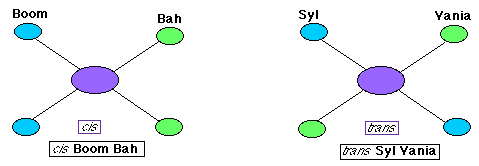
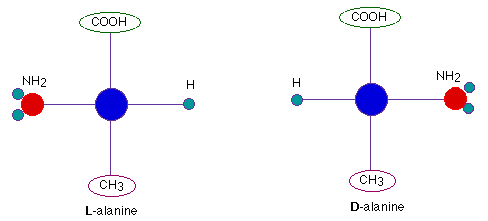
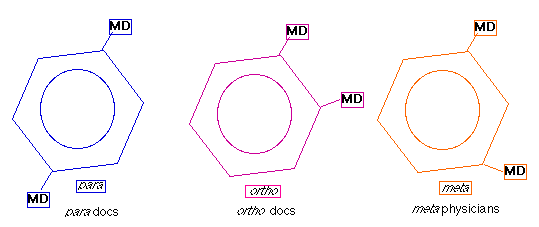
In naming ions, it is important to consider "isomers." Isomers are compounds with the same molecular formula, but different arrangements of atoms. Thus, it is important to include some signal within the name of the ion that identifies which arrangement you are talking about. There are three main types of classification, geometric, optical and structural isomers.
- Geometric isomers refers to which side of the ion atoms lie. The prefixes used to distinguish geometric isomers are cis meaning substituents lie on the same side of the ion and trans meaning they lie on opposite sides. Below is a diagram to help you remember.
- Optical isomers differ in the arrangement of four groups around a chiral carbon. These two isomers are differentiated as L and D.
- Structural isomers differentiate between the placement of two chlorine atoms around a hexagonal carbon ring. These three isomers are identified as o, m, and p. Once again we have given you a few clues to help your memory.
A pop-up nomenclature calculator is available for help when naming compounds and for practice problems.
Naming Binary Molecular Compounds
Molecular compounds are formed from the covalent bonding between non-metallic elements. The nomenclature for these compounds is described in the following set of rules.
- The more positive atom is written first (the atom which is the furthest to the left and to the bottom of the periodic table)
- The more negative second atom has an "-ide" ending.
- Each prefix indicates the number of each atom present in the compound.
Number of Atoms Prefix Number of Atoms Prefix 1 mono 6 hexa 2 di 7 hepta 3 tri 8 octa 4 tetra 9 nona 5 penta 10 deca
Examples:
CO2 = carbon dioxide
P4S10 = tetraphosphorus decasulfide
Naming Inorganic Acids
- Binary acids (H plus a nonmetal element) are acids that dissociate into hydrogen atoms and anions in water. Acids that only release one hydrogen atom are known as monoprotic. Those acids that release more than one hydrogen atom are called polyproticacids. When naming these binary acids, you merely add "hydro-" (denoting the presence of a hydrogen atom) to the beginning and "-ic acid" to the end of the anion name.
Examples:
HCl = hydrochloric acid
HBr = hydrobromic acid - Ternary acids (also called oxoacids, are formed by hydrogen plus another element plus oxygen) are based on the name of the anion. In this case, the -ate, and -ite suffixes for the anion are replaced with -ic and -ous respectively. The new anion name is then followed by the word "acid." The chart below depicts the changes in nomenclature.
Anion name Acid name hypo___ite hypo___ous acid ___ite ___ous acid ___ate ___ic acid per___ate per___ic acid
Example:
ClO4- to HClO4 => perchlorate to perchloric acid
ClO- to HClO => hypochlorite to hypochlorous acid
Naming Compounds
A detailed treatise on naming organic compounds is beyond the scope of these materials, but some basics are presented. The wise chemistry student should consider memorizing the prefixes of the first ten organic compounds:
| Number of Carbons | Prefix |
|---|---|
| 1 | meth- |
| 2 | eth- |
| 3 | prop- |
| 4 | but- |
| 5 | pent- |
| 6 | hex- |
| 7 | hept- |
| 8 | oct- |
| 9 | non- |
| 10 | dec- |
- Single bonds (alkane): suffix is "ane", formula CnH2n+2
- Double bonds (alkene): suffix is "ene", formula CnH2n
- Triple bonds (alkyne): suffix is "yne", formula CnH2n-2
- Cyclic compounds: use prefix "cyclo"
So, for example, an organic compound with the formula "C6H14" would be recognized as an alkane with six carbons, so its name is "hexane".
Examples:
N2O4 = dinitrogen tetraoxide
S2F10 = disulfur decafluoride

Tidak ada komentar:
Posting Komentar